Pengaruh konsentrasi bakteri entomopatogen Bacillus thuringiensis terhadap mortalitas larva kumbang tanduk (Oryctes rhinoceros) secara in vitro
Abstract
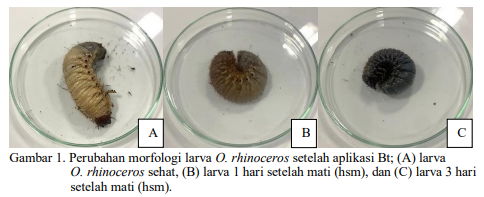
The rhinoceros beetle (Oryctes rhinoceros L.) is a major pest of oil palm that can reduce production and even cause mortality in immature plants. An environmentally friendly alternative for its control is the use of entomopathogenic bacterium Bacillus thuringiensis (Bt). This study aimed to determine the effect of different Bt concentration on the mortality of O. rhinoceros larvae, identify the most efficient concentration, and estimate the lethal concentration (LC50), and lethal time (LT50). The experiment consisted of six treatments (0%, 4%, 5%, 6%, 7%, and 8%) with four replications. Observed variables included morphological changes, larval mortalty, LC50, and LT50 values. The results showed that Bt had a significant effect on larval mortality. The 7% concentration was the most efficient, resulting in 98.8% mortality at 14 days after application (DAA) with the fastest LT50 of 7 days. The 6% and 8% treatments also achieved 100% mortality at 20 DAA but had longer LT50 (9 days). Symptoms of infection were characterized by larval bodies becoming darkened, softened, and emitting a foul odor. It can be concluded that the 7% Bt concentration was the most efficient in controlling O. rhinoceros larvae in vitro and has potential as a biological control agent to replace chemical insecticides.
References
BPS Indonesia, 2024. Statistik Indonesia 2024. Badan Pusat Statistik. Jakarta.
BPS Provinsi Lampung. 2024. Luas areal tanaman perkebunan menurut kabupaten/kota dan jenis tanaman di Provinsi Lampung (ribu ha). https://lampung.bps.go.id/id/statistic-stable/3/T0hwRGNuUlNTSGxxTTI5WFJtUk9h VXRRVUhkb1FUMDkjMw==/luas-areal-tanaman-perkebunan-menurut-kabupaten-kota-dan-jenis-tanaman-di-provinsi-lampung--ribu-ha---2023.html?year=2023. Diakses pada tanggal 25 Februari 2025 pukul 09.28 WIB.
Direktorat Statistik Tanaman Pangan, Hortikultura, dan Perkebunan. 2024. Statistik Kelapa Sawit Indonesia 2023. Badan Pusat Statistik. Jakarta.
Elsharkawy, M. M., Almasoud, M., Alsulaiman, Y. M., Baeshen, R. S., Elshazly, H., Kadi, R. H., Hassan, M. M., dan Shawer, R. 2022. Efficiency of Bacillus thuringiensis and Bacillus cereus against Rhynchophorus ferrugineus. Insects. 12(905): 1-13.
Erol, A. B., Erdogan, O., dan Karaca, I. 2023. The effect of two isolates of Beauveria bassiana (Bals.) Vull. on the larvae of confused flour beetle (Tribolium confusum du Val (Coleoptera: Tenebrionidae). International Journal of Agriculture, Environment and Food Sciences. 7(3): 533-539.
Fauzana, H. dan Ustadi. 2020. Pertumbuhan larva kumbang tanduk (Oryctes rhinoceros L.) pada berbagai media tumbuh tanaman famili Arecaceae. Jurnal Entomologi Indonesia. 17(2): 89-96.
Febrika, R., Oemry, S., dan Tarigan, M. U. 2014. Penggunaan Beauveria bassiana dan Bacillus thuringiensis untuk mengendalikan Plutella xylostella L. (Lepidoptera; Plutellidae) di laboratorium. Jurnal Online Agroekoteknologi. 2(2): 472-475.
Hermanto, S., Jusuf, E., dan Shiddiqi, M. H. 2013. Eksplorasi protein toksin Bacillus thuringiensis dari tanah di Kabupaten Tangerang. Valensi. 3(1): 48-56.
Salbiah, D., Laoh, J. H., dan Nurmayani. 2013. Uji beberapa dosis Beauveria bassiana vuillemin terhadap larva hama kumbang tanduk Oryctes rhinoceros (coleoptera; scarabaeidae) pada kelapa sawit. Jurnal Teknobiologi. 4(2):137-142.
Syahputri, M., Pujiastuti, Y., dan Suparman, S. H. K. 2025. Pemanfaatan limbah agroindustri dalam perbanyakan Bacillus thuringiensis dan toksisitasnya terhadap larva Oryctes rhinoceros. Jurnal Agrotek Tropika. 13(1): 147-156.
Tampubolon, D. Y., Pangestiningsih, Y., Zahara, F., dan Manik, F. 2013. Uji patogenisitas Bacillus thuringiensis dan Metarhizium anisopliae terhadap mortalitas Spodoptera litura Fabr (Lepidoptera: Noctuidae) di laboratorium. Jurnal Online Agroekoteknologi. 1(3): 783-793.
Wan, N. F., Fu, L., Dainese, M., Kiaer, L. P., Hu, Y. Q., Xin, F., Goulson, D., Woodcock, B. A., Vanbergen, A. J., Spurgeon, D. J., Shen, S., dan Scherber, C. 2025. Pesticides have negative effects on non-targer organisms. Nature Communications. 16(1360): 1-16
License
Copyright (c) 2026 Jurnal Proteksi Agrikultura

This work is licensed under a Creative Commons Attribution-NonCommercial 4.0 International License.